The word Marubozu means “Bald” in Japanese. There are two types of marubozu – the bullish marubozu and the bearish marubozu.

Marubozu is probably the only candlestick pattern which violates rule number 3 i.e look for prior trend. A Marubozu can appear anywhere in the chart irrespective of the prior trend, the trading implication remains the same.
- Buy strength and sell weakness
- Be flexible with patterns (verify and quantify)
- Look for prior trend
Marubozu as a candlestick with no upper and lower shadow (therefore appearing bald). A Marubozu has just the real body as shown below. However there are exceptions to this.
Bullish Marubozu:
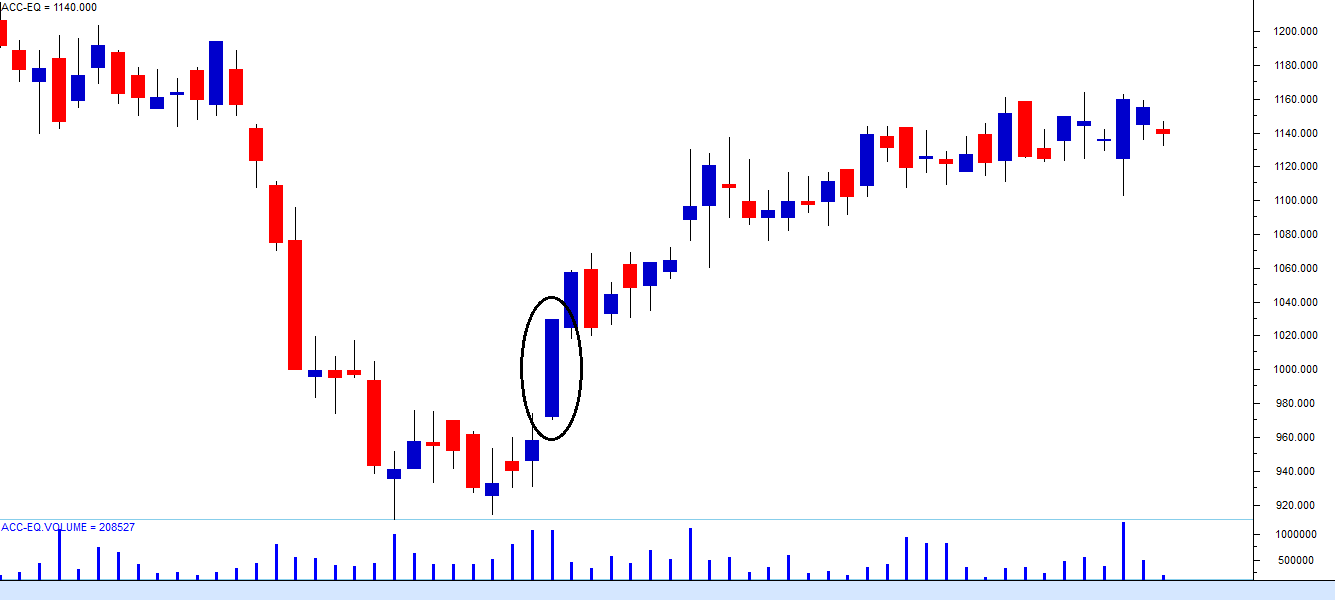
The absence of the upper and lower shadow in a bullish marubozu implies that the low is equal to the open and the high is equal to the close. Hence whenever the, Open = Low and High = close, a bullish marubozu is formed.
A bullish marubozu indicates that there is so much buying interest in the stock that the market participants were willing to buy the stock at every price point during the day, so much so that the stock closed near its high point for the day. It does not matter what the prior trend has been, the action on the marubozu day suggests that the sentiment has changed and the stock in now bullish.
The expectation is that with this sudden change in sentiment there is a surge of bullishness and this bullish sentiment will continue over the next few trading sessions. Hence a trader should look at buying opportunities with the occurrence of a bullish marubozu. The buy price should be around the closing price of the marubozu.
Bearish Marubozu:
Bearish Marubozu indicates extreme bearishness. Here the open is equal to the high and close the is equal to low. Open = High, and Close = Low.
A bearish marubozu indicates that there is so much selling pressure in the stock that the market participants actually sold at every price point during the day, so much so that the stock closed near its low point of the day. It does not matter what the prior trend has been, the action on the marubozu day suggests that the sentiment has changed and the stock is now bearish.
The expectation is that this sudden change in sentiment will be carried forward over the next few trading sessions and hence one should look at shorting opportunities. The sell price should be around the closing price of the marubozu.
 Key Points about Marubozu
- Remember the rules based on which candlesticks work
- Marubozu is the only pattern which violates rule number 3 i.e Look for prior trend
- A bullish marubozu indicates bullishness
- Buy around the closing price of a bullish marubozu
- Keep the low of the marubozu as the stoploss
- A bearish marubozu indicates bearishness
- Sell around the closing price of a bearish marubozu
- Keep the high of the marubozu as the stoploss
- An aggressive trader can place the trade on the same day as the pattern forms
- Risk averse traders can place the trade on the next day after ensuring that it obeys rule number 1 i.e Buy strength, and Sell weakness
- An abnormal candle lengths should not be traded
- Short candle indicates subdued activity
- Long candle indicates extreme activity, however placing stoploss becomes an issue.


No comments:
Post a Comment